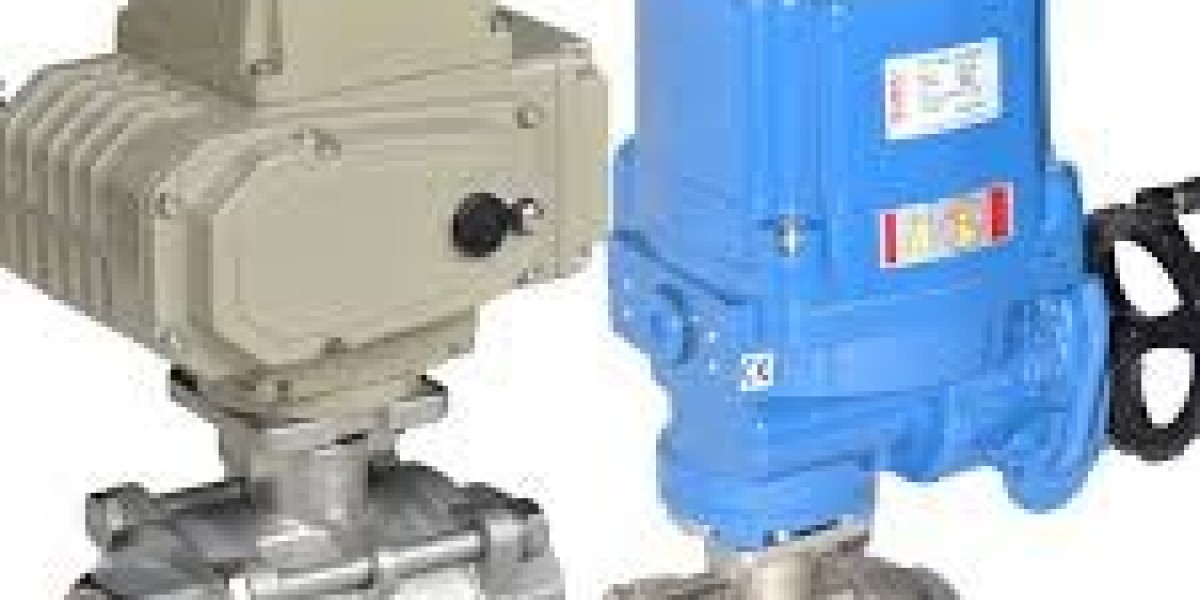

Motorized valves are widely used in automated process systems where remote operation, safety, and flow accuracy are critical. Among them, motorized ball valves and motorized butterfly valves are the most commonly compared due to their similar automation capability but different performance behavior. This article provides a detailed performance-based comparison to help industries choose the right valve for their application.
Basic Working Principle
Motorized ball valves operate using a hollow spherical ball that rotates 90 degrees to start or stop flow. When fully open, the bore aligns with the pipeline, allowing unrestricted flow.
Motorized butterfly valves use a rotating disc mounted on a shaft. Flow is regulated by changing the disc angle, making them suitable for both isolation and throttling services.
Design and Construction Performance
Motorized ball valves have a solid internal design with precision-machined balls and seats. This construction provides excellent sealing and long service life in demanding environments.
Motorized butterfly valves feature a compact and lightweight design with fewer internal components. Their slim body makes them ideal for large-diameter pipelines and space-constrained installations.
Flow Control Capability
Motorized ball valves are best suited for on-off operation. They provide full-bore flow with minimal pressure loss but are not recommended for continuous throttling.
Motorized butterfly valves offer better control in partially open positions, making them suitable for modulating and flow regulation applications.
Shutoff and Sealing Performance
Motorized ball valves deliver tight shutoff and near-zero leakage, even after repeated operating cycles. This makes them ideal for critical isolation duties.
Motorized butterfly valves provide reliable shutoff but may allow minor leakage over time, especially under high pressure or abrasive conditions.
Pressure Handling Performance
Motorized ball valves perform exceptionally well in high-pressure systems. Their robust sealing mechanism maintains reliability under fluctuating pressure conditions.
Motorized butterfly valves are generally used in low to medium pressure applications, though high-performance designs can handle higher pressures at increased cost.
Temperature Resistance
Motorized ball valves, especially metal-seated types, can handle high temperatures and are suitable for steam, thermal oil, and hot process media.
Motorized butterfly valves are commonly used in moderate temperature services. Elastomer-seated versions are temperature-limited, while metal-seated types extend the range.
Torque Requirement and Actuator Size
Motorized ball valves require higher operating torque, particularly in larger sizes, leading to bigger and heavier actuators.
Motorized butterfly valves need lower torque, allowing the use of compact actuators and reducing overall system weight.
Installation and Space Efficiency
Motorized ball valves require more installation space and stronger pipeline support due to their weight.
Motorized butterfly valves are easier to install in confined areas and large pipe diameters due to their lightweight and wafer-style design.
Maintenance and Service Life
Motorized ball valves offer long service life with minimal maintenance when used in suitable applications. Seat replacement may be required over extended operation.
Motorized butterfly valves are easier to maintain due to fewer parts, but sealing elements may wear faster in abrasive or high-cycle services.
Energy Consumption Performance
Motorized ball valves consume more electrical energy due to higher torque demand during operation.
Motorized butterfly valves are more energy-efficient, making them suitable for frequent operation and automation-heavy systems.
Cost and Lifecycle Economics
Motorized ball valves have a higher initial cost but offer long-term value in critical and high-pressure applications.
Motorized butterfly valves are more cost-effective for large sizes and moderate service conditions, offering lower installation and automation costs.
Typical Industrial Applications
Motorized ball valves are commonly used in oil and gas, chemical processing, high-pressure water lines, and critical isolation services.
Motorized butterfly valves are widely used in HVAC systems, water treatment plants, cooling circuits, and large-diameter pipelines.
Which Valve Performs Better Overall
Motorized ball valves outperform butterfly valves in sealing, pressure handling, and critical isolation performance.
Motorized butterfly valves deliver better performance in flow regulation, space efficiency, and cost-sensitive applications.
Conclusion
Both motorized ball valves and motorized butterfly valves offer excellent performance when selected correctly. Ball valves are the preferred choice for high-pressure, zero-leakage, and critical shutoff applications. Butterfly valves are ideal for large pipelines, modulating control, and cost-efficient automation. The final selection should always be based on pressure, temperature, media type, control requirement, and operational frequency.