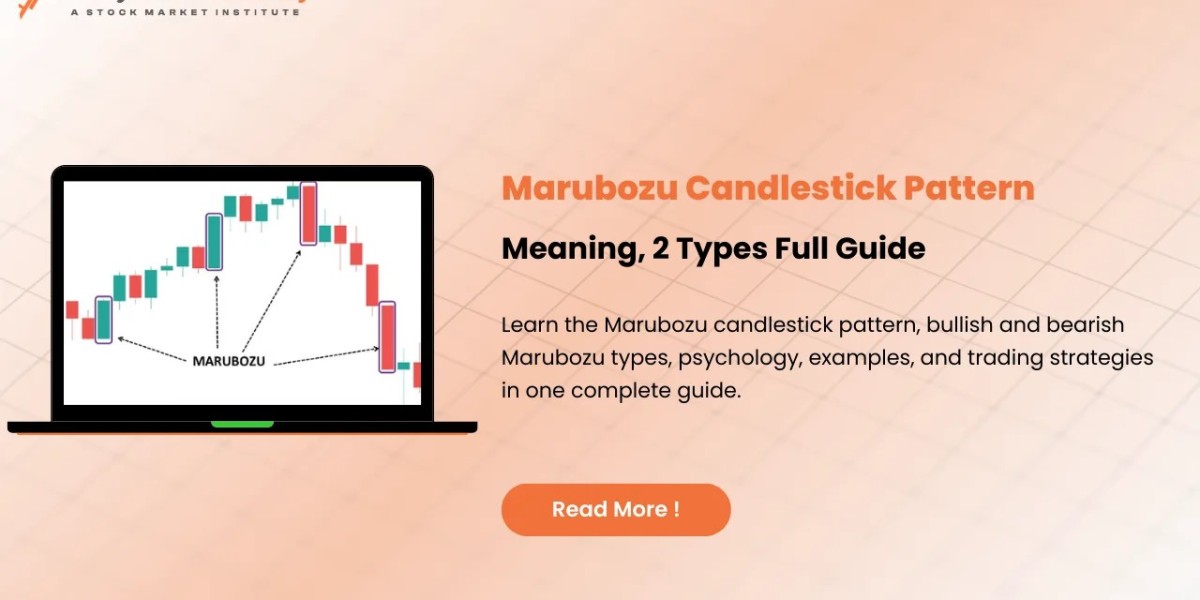

Marubozu Candlestick Pattern: The Complete Beginner's Guide
Ever noticed a long, bold candle on a trading chart without any wicks? That’s the Marubozu candlestick pattern—a powerful signal of strong market momentum. For anyone learning technical analysis or enrolled in a stock market course in India, understanding this pattern can make a big difference in your trading success.
Let’s break it down simply—without the confusing chart jargon—so you can spot and interpret a Marubozu candle like a pro.
Learn about marubozu candle types, bullish marubozu, and how to analyze them. Perfect for beginners and anyone taking a stock market course in India.
What Is a Marubozu Candlestick Pattern?
A Marubozu candlestick pattern represents a strong trend in one direction—either upward or downward. The word “Marubozu” comes from Japanese, meaning “bald” or “shaven head,” referring to its lack of shadows (wicks).
In simpler terms, it’s a solid candle showing clear dominance by buyers or sellers, depending on whether it’s bullish or bearish.
Meaning and Significance in Trading
Think of the Marubozu candle like a racecar speeding down a straight road—no pauses, no turns, no hesitation. It tells traders that one side (buyers or sellers) completely controlled the market during that period.
This clarity helps traders make confident decisions about market entry and exit points. For beginners in a stock market course in India, learning this pattern builds confidence in reading chart momentum.
Types of Marubozu Candles
There are mainly two types of Marubozu candlesticks:
Bearish Marubozu
Each one tells a different story about who’s in control of the market.
Understanding the Bullish Marubozu
A bullish marubozu forms when the opening price is the lowest and the closing price is the highest. In short: buyers dominate from start to finish.
Key traits:
No upper or lower shadows.
Color: Usually white or green.
Symbolizes strong buying pressure.
It’s a sign that traders are confident, pushing prices higher without interruption. For example, when a bullish Marubozu appears at the end of a downtrend, it might signal a potential trend reversal.
Understanding the Bearish Marubozu
A bearish marubozu is the opposite—it shows sellers taking complete control.
Key characteristics:
Opens at the highest price.
Closes at the lowest price.
Lacks upper or lower wicks.
It’s a warning sign for buyers that selling pressure is high. For short sellers, it might be a chance to ride the downward momentum.
How to Identify a Marubozu on the Chart
Identifying one is simple:
Look for a long, full-bodied candle.
Check if there are no wicks or shadows at either end.
The candle’s body color will usually tell you whether it’s bullish (green) or bearish (red).
If you can spot a candle that looks like a stick with no thin lines above or below, that’s a Marubozu!
What Does a Marubozu Indicate?
A Marubozu indicates strong market conviction. Whether bullish or bearish, it sends a clear message:
Bullish Marubozu → Buyers have full control.
Bearish Marubozu → Sellers are dominating.
In both cases, the market momentum is so strong that there’s barely any resistance in the opposite direction.
Real-World Example of Marubozu Candle
Let’s say a stock opens at ₹500 and closes at ₹550, with no price movement below ₹500 or above ₹550. The candle is solid and full-bodied—this is a bullish marubozu.
Similarly, if a stock opens at ₹550 and closes at ₹500, it forms a bearish marubozu.
These patterns often appear in breakout situations or strong trend continuations.
Difference Between Marubozu and Normal Candles
Feature | Marubozu Candle | Normal Candle |
Shadows | None | Usually present |
Market Sentiment | Clear and strong | Mixed |
Control | One-sided dominance | Shared control |
Interpretation | High conviction | Uncertain movement |
In short, a normal candle shows hesitation—but a Marubozu screams confidence.
How Traders Use Marubozu in Strategies
Traders use Marubozu patterns to:
Confirm trend direction.
Identify entry and exit points.
Spot breakouts or trend reversals.
Example: If a bullish marubozu forms after a consolidation phase, it may signal the start of a new uptrend—an ideal buy zone.
Marubozu Candlestick Pattern in Intraday Trading
Intraday traders love Marubozu candles because they offer quick signals. A bullish Marubozu after the market opens may suggest strong buying, while a bearish Marubozu can help confirm short-selling opportunities.
However, timing and confirmation with volume analysis are key.
Marubozu in Combination with Other Indicators
On its own, the Marubozu is powerful—but when paired with other tools, it’s even better:
Volume analysis: Confirms the strength behind the candle.
RSI (Relative Strength Index): Avoids false signals.
Moving averages: Validate the trend direction.
For example, a bullish Marubozu above a 50-day moving average is often seen as a sign of continued upward momentum.
Common Mistakes to Avoid
Many beginners misinterpret Marubozu candles. Here’s what to watch out for:
Ignoring context: Always consider the overall trend.
Relying solely on one candle: Use confirmations.
Overtrading every Marubozu: Not all carry strong signals.
Marubozu Candlestick in Stock Market Courses in India
If you’re planning to take a stock market course in India, you’ll likely study the Marubozu pattern early on. Courses from platforms like NSE Academy, Zerodha Varsity, and Upstox often include detailed sessions on this and other candlestick formations.
These courses teach how to combine candlestick analysis with trading psychology, risk management, and market timing for better decision-making.
Final Thoughts and Takeaways
The Marubozu candlestick pattern is one of the clearest and most reliable signals in technical analysis. It tells you who’s dominating—buyers or sellers—without needing fancy tools.
Like a lighthouse guiding ships through stormy seas, this candle helps traders navigate market uncertainty. Combined with practice and education (such as a stock market course in India), it can sharpen your trading instincts dramatically.
Frequently Asked Questions (FAQs)
1. What is the meaning of a Marubozu candlestick pattern?
It’s a candle without wicks, showing strong market sentiment—either all buying (bullish) or all selling (bearish).
2. How can I identify a bullish Marubozu?
Look for a tall green candle with no shadows, where the open is the low and the close is the high.
3. Is Marubozu suitable for beginners?
Yes. It’s one of the easiest patterns to identify and interpret, making it perfect for learners or anyone in a stock market course in India.
4. Can Marubozu appear in crypto or forex charts?
Absolutely. The Marubozu pattern applies to all asset classes—stocks, forex, commodities, and cryptocurrencies.
5. How reliable is the Marubozu pattern for trading decisions?
It’s reliable when combined with other indicators like trend lines or volume analysis. Avoid acting solely on a single Marubozu candle.