
Learn conceptual adaptation using knowledge graphs and semantic AI. Complete guide with real-world applications, implementation strategies & case studies.
Imagine teaching a computer to think like a human brain—connecting dots between different ideas, understanding context, and adapting knowledge from one situation to another. That’s exactly what conceptual adaptation using knowledge graphs and semantic AI does. It’s revolutionizing how machines understand and process information, making them smarter and more helpful than ever before.
What is Conceptual Adaptation in AI Systems?
Think of conceptual adaptation as teaching a computer to be flexible with its thinking. Just like humans can take what they know about riding a bicycle and apply some of those skills to riding a motorcycle, AI systems can now transfer knowledge between different domains.
Defining Conceptual Adaptation in Machine Learning
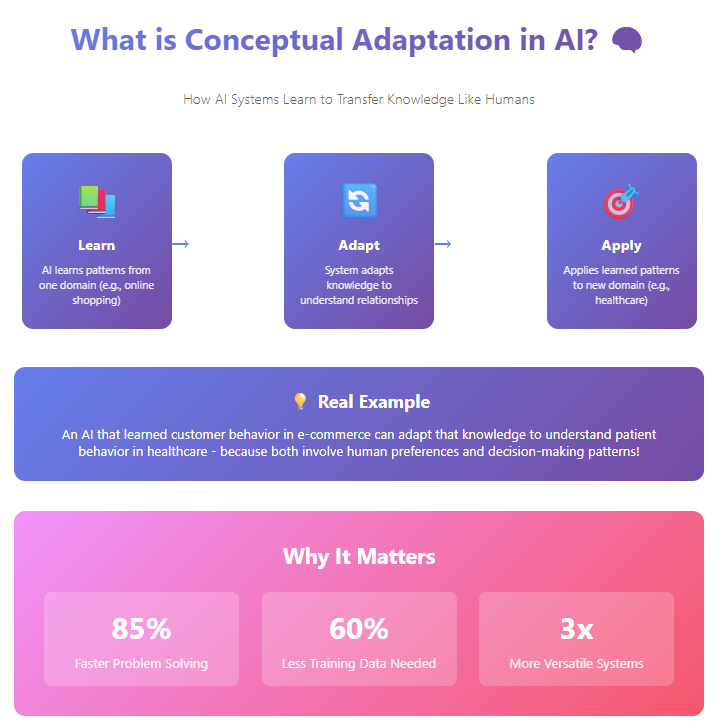
Conceptual adaptation is the ability of AI systems to take knowledge learned in one area and apply it to a completely different area. It’s like having a Swiss Army knife for intelligence—one tool that adapts to many different situations.
For example, an AI that learned about customer behavior in online shopping could adapt that knowledge to understand patient behavior in healthcare. The core concepts of human preferences and decision-making remain similar, even though the contexts are totally different.
The Role of Context in Concept Transfer
Context is everything. When you say “bank,” do you mean a financial institution or the side of a river? Humans understand this automatically, but teaching machines to grasp context has been one of AI’s biggest challenges.
Modern AI systems use contextual clues to understand meaning. They look at surrounding words, the situation, and even the user’s history to figure out what you really mean. It’s like having a really smart friend who just “gets” what you’re trying to say.
Traditional vs. Semantic-Based Adaptation Approaches
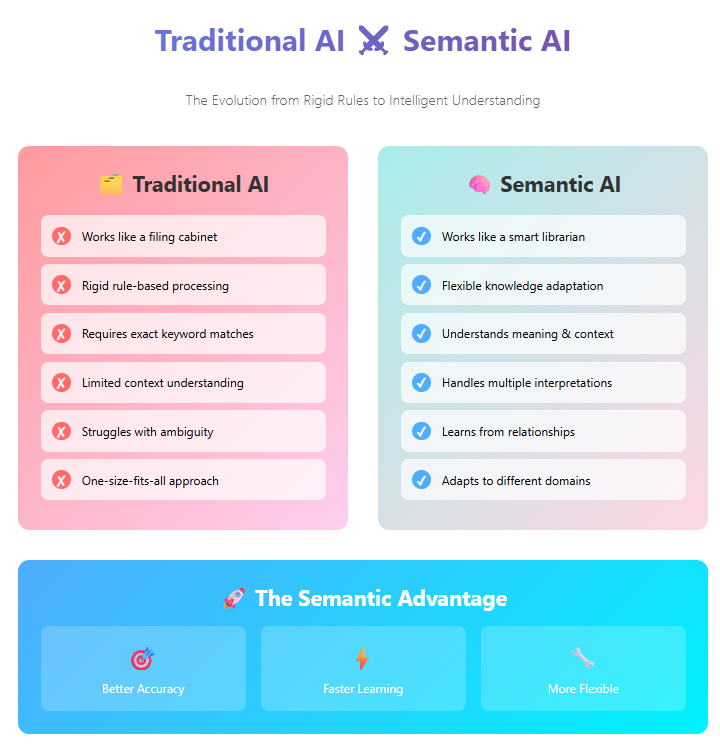
Old-school AI was like a filing cabinet—organized but rigid. You had to know exactly which drawer to open and which folder to look in. If information wasn’t in the right place, the system couldn’t find it.
Semantic-based approaches are different. They’re like having a brilliant librarian who understands not just where books are located, but what they’re actually about. This librarian can recommend books you didn’t even know you were looking for because they understand the deeper connections between ideas.
Foundation: Knowledge Graphs for Semantic Understanding
A knowledge graph is like a giant mind map that connects everything to everything else. Imagine Wikipedia, but instead of just linking articles, it understands the relationships between concepts, people, places, and ideas.
Semantic Representation in Knowledge Graphs
Think of semantic representation as giving meaning to data. Instead of just storing that “John works at Google,” a knowledge graph understands that John is a person, Google is a company, and “works at” represents an employment relationship. This deeper understanding allows for much more intelligent processing.
Entity-Relationship Modeling for Conceptual Reasoning
This is about understanding the connections between things. In real life, you know that:
- Dogs are animals
- Animals need food
- Therefore, dogs need food
Knowledge graphs work the same way, but they can handle millions of these logical connections simultaneously. They create a web of understanding that lets AI systems reason about new situations using existing knowledge.
Ontological Frameworks and Concept Hierarchies
An ontology is like a family tree for concepts. It shows how ideas are related to each other. For instance, “car” might be under “vehicle,” which is under “transportation,” which is under “human activity.”
This hierarchy helps AI understand that if something is true about vehicles in general, it’s probably true about cars specifically. It’s a way of organizing knowledge that makes reasoning more efficient and accurate.
Semantic AI: Enabling Intelligent Concept Adaptation
Semantic AI is the brain behind understanding meaning. It’s what makes the difference between a computer that can match keywords and one that actually understands what you’re talking about.
Natural Language Understanding and Concept Extraction
When you tell someone “I’m feeling blue,” they understand you’re sad, not that you’ve changed color. Semantic AI works similarly—it looks beyond the literal words to understand the intended meaning.
Modern systems can read text and automatically identify important concepts, relationships, and even emotions. They can tell the difference between “Apple the company” and “apple the fruit” based on context.
Embedding Models for Semantic Similarity
Word embeddings are like giving each word a unique fingerprint based on its meaning. Words with similar meanings have similar fingerprints. This allows computers to understand that “car” and “automobile” are basically the same thing, even though they’re different words.
These embeddings help AI systems understand that “happy” is closer to “joyful” than to “table,” which seems obvious to us but is actually a huge breakthrough for machines.
Transformer Architecture in Conceptual Reasoning
Transformers are the powerhouse behind modern AI. They’re like having multiple experts all working together, each focusing on different aspects of a problem. One might focus on grammar, another on context, and another on meaning.
The beauty of transformers is their attention mechanism—they can focus on the most important parts of information while ignoring irrelevant details, just like humans do when they’re listening to a conversation in a noisy room.
Core Mechanisms of Conceptual Adaptation
Now we get to the exciting part—how AI systems actually adapt concepts from one area to another.
Concept Mapping and Cross-Domain Transfer
Concept mapping is like creating a translation dictionary between different fields. For example, in business, you have “customers,” while in healthcare, you have “patients.” Both represent people receiving services, so the AI can transfer knowledge about customer satisfaction to patient satisfaction.
Cross-domain transfer happens when AI takes what it learned in one field and applies it to another. A system that became expert at recognizing fraud in banking could use similar pattern-recognition skills to detect fake news or identify unusual medical symptoms.
Semantic Distance Calculation and Similarity Metrics
This is about measuring how similar different concepts are. It’s like having a ruler for ideas. The system can determine that “physician” and “doctor” are very close (almost identical), while “physician” and “engineer” are more distant but still both professionals.
These measurements help AI systems understand which knowledge is most relevant to transfer from one situation to another.
Dynamic Graph Updates and Concept Evolution
Knowledge isn’t static—it grows and changes. Dynamic graphs are like living encyclopedias that update themselves as new information becomes available. When COVID-19 emerged, these systems quickly learned about the new virus and connected it to existing knowledge about pandemics, respiratory diseases, and public health.
Multi-Modal Concept Integration
This integration makes AI systems much more robust and human-like in their understanding.
This is about combining different types of information—text, images, sounds, and more. A multi-modal system doesn’t just read about cats; it can see pictures of cats, hear them meow, and understand that all these different inputs represent the same concept.
Technical Implementation Strategies
Let’s dive into how these systems actually work behind the scenes, but in simple terms.
Graph Neural Networks for Conceptual Reasoning
Graph Neural Networks (GNNs) are specialized AI systems designed to work with connected data. Think of them as detectives who are really good at finding patterns in social networks. They can look at how concepts are connected and use those connections to make smart predictions.
For example, if a GNN knows that aspirin reduces pain and that headaches cause pain, it can reasonably suggest that aspirin might help with headaches, even if it wasn’t explicitly taught that connection.
Knowledge Graph Embeddings
These are ways of representing knowledge graphs in a format that computers can process efficiently. Imagine taking a complex 3D sculpture and creating a detailed blueprint that captures all its important features. That’s what embeddings do for knowledge graphs.
Different embedding methods (like TransE, RotatE, and ComplEx) are like different ways of creating these blueprints, each with their own strengths for different types of problems.
Semantic Search and Concept Retrieval Systems
Traditional search is like looking for books by their titles. Semantic search is like having a librarian who understands what you’re really looking for, even if you can’t quite articulate it properly.
When you search for “heart problems,” a semantic system might also show you results about cardiovascular disease, cardiac issues, and chest pain—because it understands these are all related concepts.
Real-Time Adaptation Algorithms
Real-time adaptation means AI systems get smarter with every interaction, continuously refining their understanding of concepts and relationships.
These are systems that learn and adapt on the fly. Imagine a GPS that doesn’t just give you directions but also learns from traffic patterns, road closures, and even your personal preferences to constantly improve its suggestions.
Advanced Techniques and Methodologies
These are the cutting-edge approaches that make conceptual adaptation even more powerful.
Few-Shot Learning with Knowledge Graph Constraints
Few-shot learning is like being able to recognize a new animal species after seeing just a few examples. Traditional AI might need thousands of pictures to learn what a zebra looks like, but few-shot learning can figure it out from just a handful of images.
When combined with knowledge graphs, this becomes even more powerful. The system might see a few pictures of a zebra and immediately understand it’s related to horses, lives in Africa, and eats grass—because it can connect these new examples to existing knowledge.
Meta-Learning for Cross-Domain Concept Transfer
Meta-learning is “learning how to learn.” It’s like developing a general strategy for picking up new skills quickly. A meta-learning system doesn’t just learn specific facts; it learns patterns about how knowledge transfers between different domains.
This means the system gets better at adaptation over time, becoming more efficient at applying knowledge from one area to another.
Neuro-Symbolic Integration for Robust Adaptation
This combines the pattern-recognition power of neural networks with the logical reasoning of symbolic AI. It’s like having both an artist (who sees patterns and intuitions) and a mathematician (who follows logical rules) working together.
This combination makes AI systems more robust and reliable, especially in critical applications like healthcare or autonomous vehicles.
Attention Mechanisms in Graph-Based Reasoning
Attention mechanisms help AI focus on what’s most important. When reading a long document, humans naturally pay more attention to key points and skim over less important details. Attention mechanisms give AI systems this same ability.
In graph-based reasoning, attention helps the system focus on the most relevant connections and relationships, making processing more efficient and accurate.
Real-World Applications and Use Cases
Let’s look at how these technologies are actually being used to solve real problems.
Healthcare: Medical Concept Adaptation and Drug Discovery
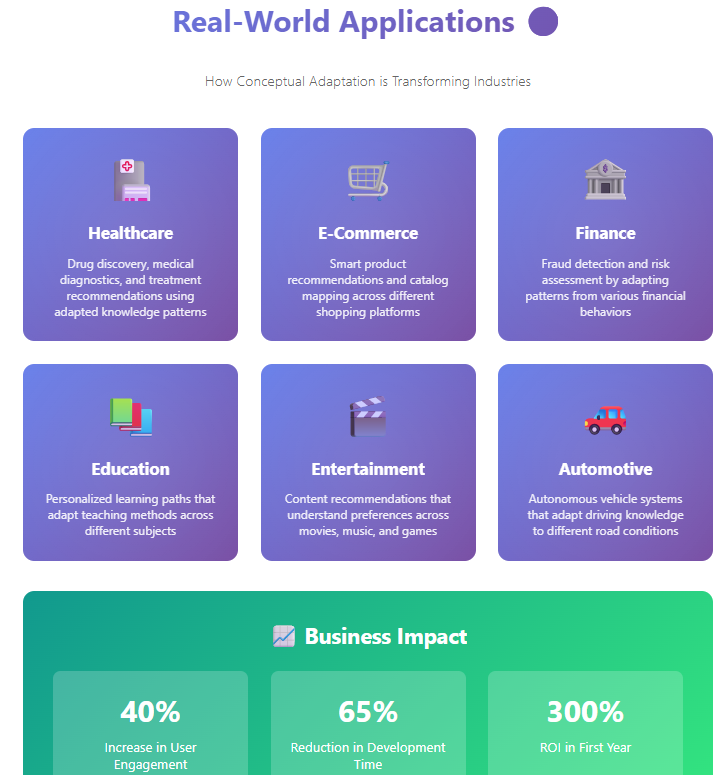
In healthcare, conceptual adaptation is saving lives by helping doctors understand connections between different medical conditions. A system might notice that patients with a certain heart condition often develop kidney problems, even if this connection wasn’t obvious before.
For drug discovery, AI can adapt knowledge about how existing drugs work to predict how new compounds might behave. This dramatically speeds up the process of finding new treatments.
E-commerce: Product Recommendation and Catalog Mapping
Online shopping platforms use conceptual adaptation to understand that someone interested in camping gear might also like hiking boots, outdoor clothing, and travel accessories. The system understands the conceptual relationships between these products.
Catalog mapping helps when companies merge or when products need to be categorized across different systems. The AI can understand that “smartphone” and “mobile phone” refer to the same type of product.
Financial Services: Risk Assessment and Fraud Detection
Banks use these systems to understand patterns of fraudulent behavior. If scammers develop a new type of fraud, the system can adapt existing knowledge about previous scams to identify and prevent the new threat.
Risk assessment benefits from understanding how different economic factors relate to each other. The system might understand that rising unemployment in a specific region could affect loan default rates.
Educational Technology: Personalized Learning Pathways
Educational AI systems can adapt to different learning styles and knowledge levels. If a student is struggling with algebra, the system might recognize that they need to strengthen their understanding of basic arithmetic first.
These systems can also transfer knowledge about what teaching methods work well for certain types of learners to new subjects or contexts.
Performance Optimization and Challenges
Even the best systems face challenges. Here’s how to address them.
Computational Complexity and Graph Traversal Efficiency
Large knowledge graphs can be computationally expensive to process. It’s like trying to find the shortest route through a city with millions of streets—technically possible, but it takes smart algorithms to do it efficiently.
Solutions include:
- Indexing: Like creating a table of contents for faster lookup
- Caching: Storing frequently accessed information for quick retrieval
- Parallel processing: Using multiple processors to handle different parts simultaneously
Handling Semantic Ambiguity and Context Disambiguation
Words and concepts can have multiple meanings. “Bank” could mean a financial institution or the side of a river. The challenge is teaching AI to understand which meaning is intended based on context.
Techniques include:
- Context analysis: Looking at surrounding words and phrases
- User history: Considering previous interactions
- Domain knowledge: Understanding the subject area being discussed
Quality Assurance and Validation Frameworks
Ensuring quality in AI systems is like having a good editor for a newspaper. You need multiple layers of checking:
- Automated testing: Computer programs that check for obvious errors
- Human review: Expert evaluation of results
- User feedback: Learning from how people actually use the system
- Continuous monitoring: Watching for problems in real-time
Bias Mitigation in Conceptual Transfer
AI systems can inadvertently learn and perpetuate human biases. For example, if historical data shows that most engineers were men, the system might incorrectly assume that engineering is a male profession.
Mitigation strategies include:
- Diverse training data: Including examples from all groups
- Bias testing: Specifically checking for unfair outcomes
- Regular auditing: Ongoing evaluation of system behavior
- Inclusive design: Involving diverse teams in development
Building Conceptual Adaptation Systems
Here’s a practical guide to building these systems.
Architecture Design Patterns
Think of architecture as the blueprint for your AI system. Good architecture is like good city planning—everything needs to be in the right place and connected properly.
Common patterns include:
- Hub and spoke: Central knowledge repository with specialized modules
- Layered approach: Different levels of abstraction, from raw data to high-level concepts
- Microservices: Small, specialized components that work together
Data Pipeline and Knowledge Graph Construction
Building a knowledge graph is like constructing a vast library. You need to:
- Collect information from various sources
- Clean and organize the data
- Identify relationships between different pieces of information
- Validate that everything makes sense
- Update regularly as new information becomes available
The key is starting with high-quality, well-structured data and building from there.
Model Training and Evaluation Metrics
Training an AI model is like teaching a student. You need:
- Good examples to learn from
- Regular tests to check progress
- Feedback to correct mistakes
- Practice with different types of problems
Evaluation metrics help you understand how well your system is performing. Common metrics include accuracy (how often it’s right), precision (how relevant its answers are), and recall (how much relevant information it finds).
Deployment and Scalability Considerations
Deployment is about making your system available to users. Key considerations include:
Think of it like opening a restaurant—you need to handle busy periods, ensure food quality, keep customers safe, and continuously improve your menu.
- Performance: Can it handle many users at once?
- Reliability: Does it work consistently?
- Security: Is user data protected?
- Maintainability: Can it be updated and improved easily?
Evaluation Metrics and Benchmarking
How do you know if your system is working well? Here are the key measures.
Semantic Similarity Assessment
This measures how well the system understands relationships between concepts. Good systems should recognize that “car” and “automobile” are nearly identical, while “car” and “airplane” are related but different.
Testing involves comparing the system’s understanding with human judgment across thousands of concept pairs.
Adaptation Accuracy and F1 Scores
Accuracy measures how often the system gets things right. F1 scores balance between finding all relevant information (recall) and ensuring that found information is actually relevant (precision).
Think of it like a search engine—you want it to find all the relevant websites (high recall) but not show you a bunch of irrelevant ones (high precision).
Cross-Domain Transfer Success Rates
This measures how well knowledge transfers between different fields. A good system might successfully apply knowledge from retail customer service to healthcare patient care, adapting general principles of human interaction to specific contexts.
Human Evaluation and Expert Validation