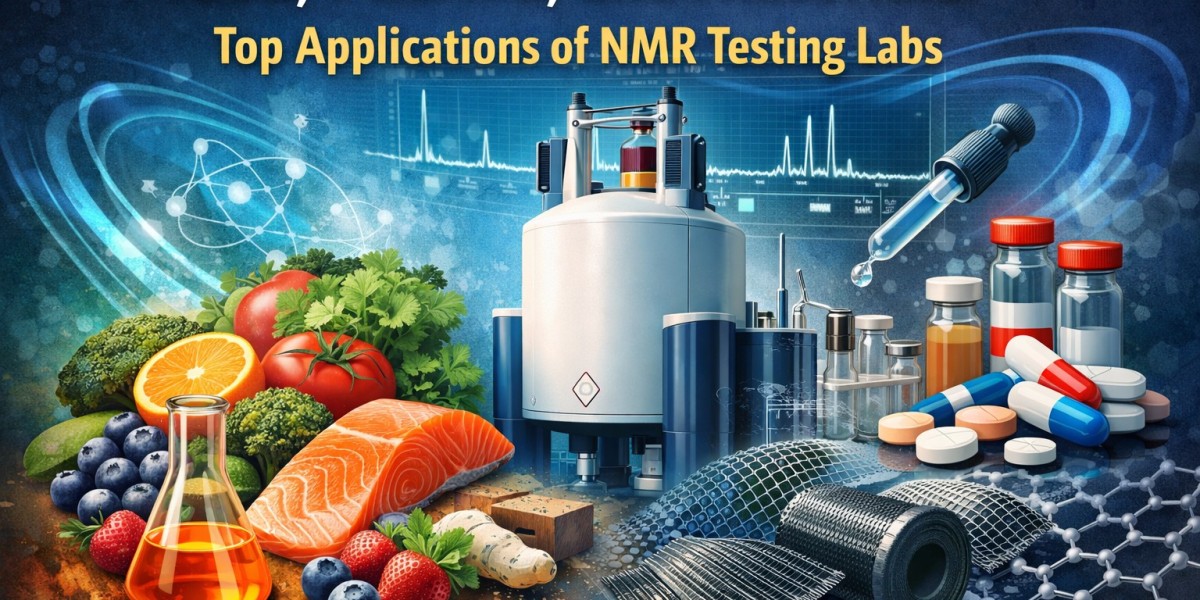

As industries demand higher product quality, safety, and performance, analytical techniques must deliver deeper molecular insights with exceptional accuracy. NMR Testing Labs have become essential across food, pharmaceutical, and materials science sectors due to their ability to analyze chemical composition, molecular structure, and dynamic behavior—often without destroying the sample.
At the core of these laboratories is Nuclear Magnetic Resonance spectroscopy (NMR), a powerful method that provides unmatched information about molecular identity, purity, and interactions. Below is a detailed look at how NMR testing labs support three of the most critical industrial domains.
Understanding NMR Testing Labs
NMR testing labs use high-field magnets and radiofrequency signals to study how atomic nuclei respond in a magnetic field. By analyzing these responses, scientists can determine:
Molecular structure
Chemical composition
Functional groups and bonding
Molecular motion and dynamics
Quantitative concentration of compounds
Unlike many analytical techniques, NMR is non-destructive, highly reproducible, and suitable for solids, liquids, gels, and semi-solids—making it ideal for diverse applications.
Applications of NMR Testing Labs in the Food Industry
Food quality assurance has evolved far beyond visual inspection and basic chemical tests. NMR testing labs now play a vital role in ensuring authenticity, safety, and nutritional accuracy.
Food Authentication & Anti-Adulteration
Food fraud is a global concern. NMR can identify subtle differences in molecular fingerprints, allowing labs to detect adulteration in:
Edible oils (olive, mustard, sunflower)
Honey and syrups
Dairy products
Fruit juices and beverages
This helps manufacturers protect brand integrity and meet international food safety standards.
Nutritional & Compositional Analysis
NMR provides simultaneous measurement of multiple components, including:
Fats and fatty acid profiles
Sugars and carbohydrates
Proteins and amino acids
Water and moisture content
This supports accurate nutritional labeling and regulatory compliance.
Shelf-Life & Stability Studies
Chemical changes during storage can affect taste, safety, and quality. NMR tracks oxidation, fermentation, and degradation processes over time, helping determine realistic shelf-life claims.
Detection of Contaminants
NMR testing labs can identify unwanted substances such as:
Chemical residues
Packaging-related contaminants
Migration products
This ensures food safety without extensive sample preparation.
Applications of NMR Testing Labs in the Pharmaceutical Industry
The pharmaceutical industry relies heavily on NMR testing labs due to the need for absolute molecular certainty at every stage of drug development.
Structural Elucidation of APIs
NMR is one of the most trusted techniques for confirming the chemical structure of:
Active pharmaceutical ingredients (APIs)
Drug intermediates
By-products and metabolites
It ensures the correct molecule is synthesized before moving to costly clinical stages.
Purity & Impurity Profiling
Even trace impurities can impact drug safety. NMR detects:
Process-related impurities
Degradation products
Residual solvents
This supports stringent regulatory submissions and batch release testing.
Quantitative NMR (qNMR)
qNMR allows direct and accurate quantification of compounds without extensive calibration curves, making it ideal for:
Reference standard qualification
Assay validation
Stability testing
Drug Stability & Degradation Studies
NMR monitors molecular changes under stress conditions such as heat, humidity, light, and oxidation—critical for shelf-life determination.
Polymorphism & Solid-State Analysis
Different crystal forms of a drug can affect solubility and bioavailability. Solid-state NMR helps identify polymorphs and study solid formulations.
Applications of NMR Testing Labs in Materials Science
Materials innovation depends on understanding molecular structure and behavior at a fundamental level. NMR testing labs are indispensable in this field.
Polymer Characterization
NMR provides detailed insights into:
Polymer backbone structure
Copolymer composition
Chain branching and cross-linking
Molecular weight distribution
This is essential for plastics, elastomers, adhesives, and resins.
Composites & Coatings
NMR helps study curing reactions, filler dispersion, and bonding in advanced composites and coatings, improving mechanical strength and durability.
Petrochemical & Fuel Analysis
Hydrocarbon composition, aromatic content, and chemical distribution in fuels and lubricants can be accurately assessed using NMR.
Energy & Battery Materials
In lithium-ion batteries and other energy storage systems, NMR is used to analyze:
Ion transport mechanisms
Electrolyte stability
Degradation pathways
Advanced Functional Materials
NMR supports R&D in nanomaterials, biomaterials, and smart materials by revealing molecular interactions and structural changes.
Why Industries Depend on NMR Testing Labs
NMR testing labs are trusted across industries because they offer:
Non-destructive analysis
Exceptional accuracy and reproducibility
Minimal sample preparation
Multi-component analysis in a single run
Regulatory-ready, traceable results
High-field and multi-nuclear NMR systems allow labs to analyze hydrogen, carbon, phosphorus, fluorine, and other nuclei for deeper insights.
Outsourcing to NMR Testing Labs: A Strategic Advantage
Establishing an in-house NMR facility requires significant investment, skilled operators, and ongoing maintenance. As a result, many organizations choose outsourced NMR testing labs to gain:
Access to advanced instrumentation
Expert interpretation and reporting
Faster turnaround times
Cost efficiency
Compliance-focused documentation
This approach enables companies to focus on innovation while relying on specialists for complex analysis.
Conclusion
From detecting food adulteration and ensuring pharmaceutical purity to enabling cutting-edge materials research, NMR Testing Labs are a cornerstone of modern analytical science. Their ability to provide detailed molecular-level insights makes them indispensable in industries where quality, safety, and performance cannot be compromised.
As products become more complex and regulatory expectations continue to rise, the role of NMR testing labs will only expand—driving better science, safer products, and smarter materials for the future.