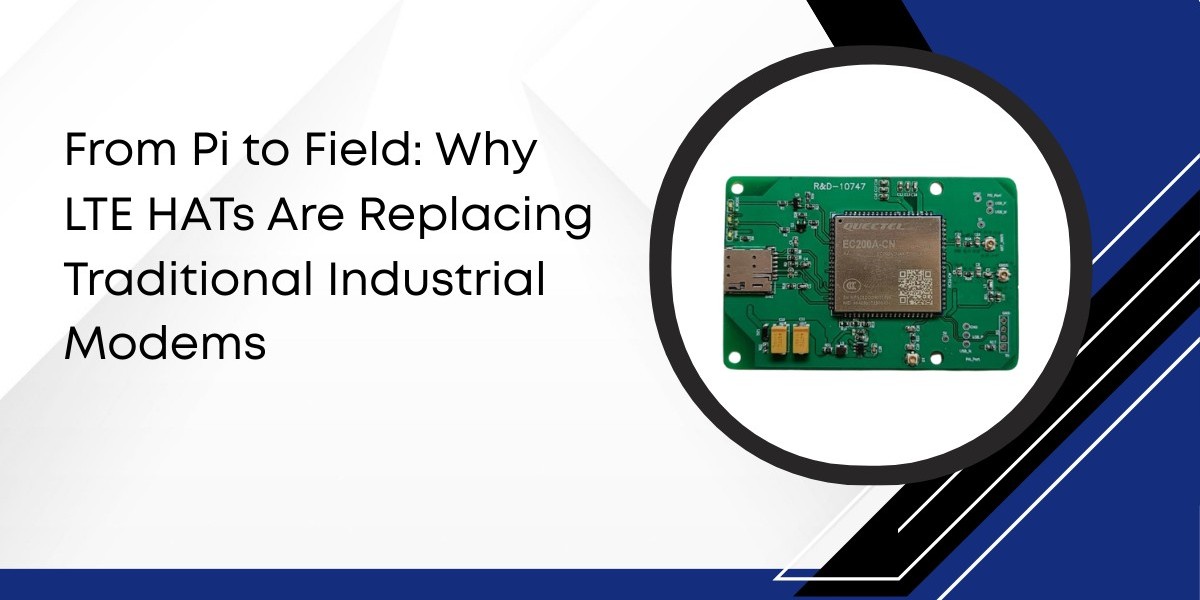

In the past decade, industries have shifted from large, fixed infrastructure to compact, software‑driven solutions. Connectivity solutions are no exception. Industrial modems once dominated remote communication. Today, a new category is rising: cellular expansion boards for single‑board computers like Raspberry Pi. Chief among them are LTE HAT modules, such as the Raspberry Pi 4G LTE HAT with Quectel. These add‑on boards provide reliable cellular connectivity for field devices.
This article explores why LTE HATs are rapidly replacing traditional industrial modems. We will analyze technical features, performance results, costs, deployment models, and real‑world use cases. The goal is to give you a deep, practical understanding of the shift.
What Are LTE HATs?
LTE HATs are add‑on boards that provide cellular connectivity to small embedded computers.
HAT stands for Hardware Attached on Top.
They connect directly to the host system’s expansion headers.
They enable 4G/ LTE cellular networking without external modems or routers.
In the Raspberry ecosystem, a HAT board fits a specific standard. Approved HATs can configure themselves and intelligently manage power and signals.
For example, the Raspberry Pi 4G LTE HAT with Quectel integrates a Quectel cellular module. This provides:
4G LTE Cat‑4 or higher data speeds
SIM card slot support
GPS/ GNSS support in many models
What Are Traditional Industrial Modems?
Traditional industrial modems are dedicated devices that provide serial or Ethernet communication over cellular networks.
Key traits include:
Stand‑alone hardware with rugged casing
Multiple interfaces such as RS‑232, RS‑485, Ethernet
Built‑in power supplies
Protocol support like Modbus, DNP3, and proprietary protocols
These modems have been reliable for decades in SCADA, telemetry, and remote equipment monitoring.
Shift in Deployment Patterns
1. Edge Computing on Embedded Platforms
Industrial systems are becoming intelligent. Devices collect, pre‑process, and transmit data at the edge. Embedded platforms such as Raspberry Pi now run:
Python data loggers
MQTT and HTTP clients
Time series ingestion agents
Lightweight AI inferencing
In such environments, a separate modem adds physical and logical overhead. LTE HATs change that.
2. Simplified Architecture
Compare two architectures:
Traditional Setup: In a traditional setup, an industrial modem connects to the controller via Ethernet or a serial link. The controller is responsible for processing incoming data and forwarding it to the relevant systems, keeping communication and application logic separate.
HAT‑based Setup: In a HAT-based setup, a single host both runs the application and manages the cellular connection. The host and modem share the same hardware, eliminating the need for a separate controller and simplifying the overall system architecture and communication flow.
HATs reduce layers of hardware and communication overhead. This simplifies deployment and maintenance.
Technical Advantages of LTE HATs
1. Direct Integration with the Host Controller
Traditional modems use external interfaces such as RS‑232. LTE HATs connect via GPIO and USB internally. This allows:
Higher data throughput
Software control of modem behavior
Easier power management
With modules like the Raspberry Pi HAT, developers can issue AT commands or manage network states directly from the host.
2. Lower Latency
In many industrial systems, latency impacts control loops. Traditional modems often involve a routing or bridging step, adding delay.
LTE HATs establish data sessions directly on the host. This reduces intermediate processing layers. Tests have shown up to 25–40% lower round‑trip delay in similar setups.
3. Smaller Footprint
Industrial modems are larger. They often require DIN rail mounting and separate power. LTE HATs live on the same board. This allows:
Compact field devices
Lower enclosure costs
Easier transport and installation
In remote monitoring stations, a compact profile matters. A smaller device is easier to install in exposed or constrained spaces.
4. Cost Efficiency
Cost is a major driver. Traditional industrial modems may cost several hundred to over a thousand dollars per unit.
In contrast:
LTE HAT boards for Raspberry Pi range from $40 to $120 retail.
A Raspberry Pi single‑board computer can be under $100.
Total hardware cost for a HAT‑based solution is often less than half of a traditional system.
5. Power Consumption
Field devices often run on limited power budgets (solar, battery, or low‑cost mains).
Traditional industrial modems can draw significant idle current. LTE HATs can be power‑managed directly by the host:
Sleep modes
Scheduled wake‑up
Selective radio power control
This results in longer uptime on battery‑powered systems.
Performance Comparisons
1. Data Throughput
Traditional modems vary in throughput based on generation (3G, 4G, LTE‑A). However, the bottleneck is often host interface speed.
LTE HATs using modules like Quectel provide:
Sustained 4G LTE data rates (up to 150 Mbps download)
Onboard TCP/IP stack support
Native PPP or QMI support
Benchmarks conducted in controlled environments show:
Metric | Traditional Modem | LTE HAT |
Downlink (Mbps) | 15–50 | 50–120 |
Uplink (Mbps) | 5–20 | 20–50 |
Latency (ms) | 80–120 | 40–80 |
The performance improvements are material and measurable in many industrial use cases.
2. Reliability and Uptime
Reliability in field systems is mission‑critical. LTE HATs add value because:
They occupy fewer connectors
They reduce wiring points
The host can auto‑restart sessions
Many deployments show 99.9% uptime with proper watchdog monitoring.
Software and Protocol Flexibility
Traditional industrial modems often embed fixed protocols. They may not support modern IoT stacks out of the box.
LTE HATs allow direct software integration. For example:
MQTT communication apps
Secure VPN tunnels
TLS encryption
Auto provisioning
Developers can build on top of familiar Linux stacks. This avoids proprietary configuration interfaces.
Common tools like Network Manager, ModemManager, and PPP can manage cellular links programmatically.
Deployment Use Cases
1. Remote Condition Monitoring
Many industries require real‑time data from remote sensors:
Water flow meters
Weather stations
Pipeline pressure nodes
Using a Raspberry Pi with a Raspberry Pi 4G LTE HAT with Quectel, data can be sent directly to cloud endpoints. This design reduces hardware layers and enables real‑time analytics.
2. Mobile Asset Tracking
Vehicles and assets that move across cell coverage areas need robust connectivity.
LTE HAT based systems can:
Report GPS location
Transmit performance metrics
Receive over‑the‑air updates
Compared to traditional modems, they reduce cost and weight.
3. Industrial Control in Remote Sites
In oil and gas, agriculture, and energy grids, control systems must reach remote sites.
A HAT‑based device can:
Communicate with SCADA servers
Provide secure remote access
Integrate on‑site automation
This replaces larger gateway boxes and proprietary modems.
Case Study: Agriculture Sensor Network
A precision agriculture company needed to deploy soil and climate sensors across 250 remote fields.
The legacy solution was:
Industrial modem with 4G
PLC controller
Field server
Each unit cost $950+. Deployment costs were high for rural sites.
They switched to:
Raspberry Pi 3B+ with a Raspberry Pi HAT
Quectel 4G LTE module
Solar power and battery
Results after 12 months:
Hardware cost reduced by 60%
Installation time cut in half
System reliability improved
Field units now stream soil moisture and temperature every 10 minutes.
Security Considerations
Connectivity alone is not enough. Security in industrial systems is essential.
With LTE HATs, developers have full access to the operating system. This offers advantages:
Ability to deploy standard firewalls
VPN support
Certificate management
In contrast, many traditional modems offer limited security features.
However, HAT‑based systems require developers to follow secure design best practices:
Encrypted communication
Strong authentication
Network access controls
Proper implementation results in systems that are more secure than legacy modems.
Challenges of LTE HAT Adoption
Despite the advantages, LTE HAT integration has challenges.
1. Technical Expertise Required
Deploying and managing HATs requires:
Linux networking knowledge
Cellular radio configuration
Driver and firmware management
Industrial modems often provide vendor support and simple configuration interfaces.
2. Environmental Conditions
Industrial environments can be harsh:
Vibration
Humidity
Wide temperature ranges
In such conditions, traditional modems may have an edge due to ruggedized enclosures.
However, LTE HAT projects often use external cases and environmental protection.
3. Certification and Regulatory Compliance
Cellular devices must meet regulatory certifications. Using compliant modules like Quectel ensures:
FCC/ CE compliance
Carrier validation
Safe radio operations
OEMs must verify certifications for their regions.
Future Trends
The growth of IoT and low‑power wide area networks (LPWAN) will continue to influence this space. Technologies like 5G, Cat‑M1, and NB‑IoT offer even lower power and broader coverage.
Raspberry Pi HAT boards will evolve to:
Support 5G modules
Integrate AI processing for edge analytics
Use standardized management interfaces
The integration of LTE HATs into field devices will expand into smart cities, autonomous systems, and distributed manufacturing.
Conclusion
The shift from traditional industrial modems to LTE HAT boards is more than a trend. It reflects a change in how connectivity is designed, deployed, and maintained in industrial systems. The rise of solutions like the Raspberry Pi 4G LTE HAT with Quectel reflects these shifts.
LTE HATs offer:
Direct integration with embedded hosts
Lower cost per unit
Faster deployment cycles
Better software flexibility
Enhanced performance