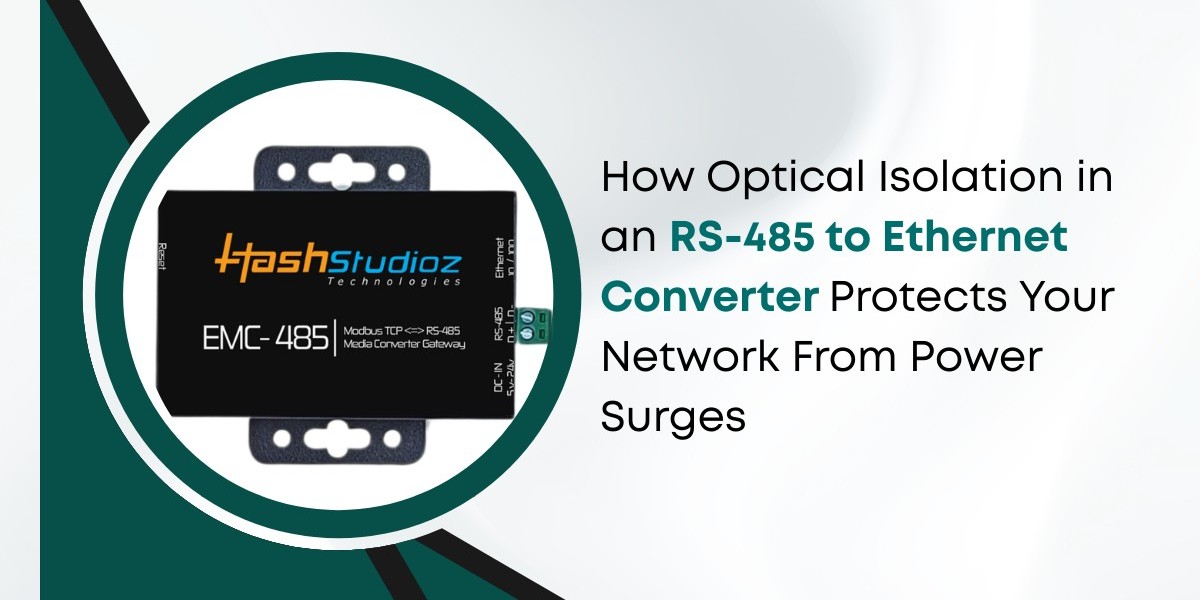

Modern industrial networks demand reliable data communication across various devices. In many automation systems, especially industrial control and building management, an RS-485 to Ethernet Converter or RS-485 to LAN Converter connects serial devices to Ethernet networks. These converters enable long-distance communication, remote monitoring, and integration with central servers. However, industrial networks often face power surges, voltage spikes, and electrical noise. These events can damage sensitive devices, cause data loss, and trigger system downtime. Optical isolation is a key technology that protects network equipment from these electrical threats.
Serial Communication in Industrial Networks
1. What Is RS-485?
RS-485 is a widely used serial communication standard.
It uses differential signaling for noise resistance.
It supports multi-drop communication over long distances (up to 1200 meters).
Typical applications include sensors, motor controllers, human-machine interfaces (HMIs), and access panels.
2. Why Connect Serial Devices to Ethernet?
High-Speed Data Transfer: Connecting serial devices to Ethernet allows significantly faster data transmission compared to traditional RS-232 or RS-485 connections. This enables quick communication between access control devices and central systems, improving response times and overall operational efficiency.
Remote Access Over IP Networks: Ethernet connectivity allows serial devices to be accessed and managed remotely via IP networks. Administrators can monitor, configure, and troubleshoot access control systems from central offices or cloud platforms without needing physical presence at each device location.
Simplified Cabling: Ethernet networks reduce the complexity of wiring required for connecting multiple serial devices. Instead of running individual serial cables to each device, standard network infrastructure can be used, lowering installation costs and simplifying maintenance across buildings or campuses.
Scalability Across Large Sites: Using Ethernet makes it easier to scale access control systems across large sites or multiple locations. RS-485 to Ethernet or RS-485 to LAN converters transform serial data into network packets, allowing seamless integration of legacy devices into centralized software and cloud systems.
Electrical Noise and Power Surges: The Industrial Challenge
Industrial sites often contain motors, heavy machinery, welding equipment, and variable frequency drives.
These devices can produce:
Voltage spikes
Electromagnetic interference (EMI)
Ground potential differences
According to multiple studies, electrical disturbances cause up to 40% of industrial communication faults. These faults can lead to:
Device damage
Communication loss
Safety system failure
Power surges pose a significant risk. They can originate from lightning strikes, switching events in power systems, or sudden load changes. In sites with mixed high-power and low-power components, even normal operation can create harmful electrical events on communication lines.
What Is Optical Isolation?
Optical isolation is a protection method that separates electrical connections between circuits using light. It uses components such as:
Light-emitting diodes (LEDs)
Photodetectors (phototransistors or photodiodes)
How Optical Isolation Works in RS-485 Converters
In an RS-485 to Ethernet Converter or RS-485 to LAN Converter, optical isolation separates the RS-485 side from the Ethernet and power circuits. The converter typically contains:
1. Isolated Serial Interface
In an RS-485 to Ethernet or RS-485 to LAN converter, optical isolation separates the RS-485 port from the rest of the device. Optical components transmit data across a barrier, preventing direct electrical contact and protecting sensitive circuits from surges.
2. Isolated Power Input
The power lines supplying the RS-485 interface are electrically isolated from the Ethernet side. This ensures that voltage spikes or power fluctuations on the serial side do not travel through the converter to the network or other connected devices, enhancing system reliability.
3. Common Ground Protection
Optical isolation prevents currents from one side of the converter from affecting the ground reference on the other side. This reduces the risk of ground loops, electrical interference, and damage to connected equipment, especially in industrial or long-distance installations.
4. Data Transfer Across the Barrier
In simplified operation, RS-485 lines send serial data to the converter, and optical isolators transmit this data across the internal barrier. The Ethernet side receives the signal without sharing electrical circuits, maintaining safe separation between networks.
5. Protection Against Harmful Voltages:
By isolating the RS-485 interface from the Ethernet and power circuits, the converter prevents harmful voltage spikes from reaching sensitive network components. This is essential in environments with motors, alarms, or other electrical equipment that can generate surges.
Why Electrical Isolation Matters
1. Protection From Power Surges
Power surges can travel through communication cables.
Without isolation:
Surge energy enters the converter.
It travels to the Ethernet network.
It damages network switches, servers, and connected devices.
With optical isolation:
Surge energy stops at the isolator.
The isolated side prevents high voltages from crossing boundaries.
Critical Ethernet equipment remains safe.
2. Protection From Ground Loops
In large installations, devices often connect to different power sources. This creates slight ground potential differences. These differences can produce:
Ground loop currents
Data errors
Communication failures
Optical isolation breaks ground links. This stops loop currents and ensures clean signal transmission.
Technical Details of Optical Isolation
1. Isolation Voltage Ratings
Converters use components rated for specific isolation voltages. Common values:
1500 VDC
3000 VAC
These ratings define the maximum voltage the isolation barrier can withstand without failure. Higher ratings provide stronger protection.
2. Response Time
Good optical isolators transfer signals with minimal delay. Industrial networks may require:
High baud rates (e.g., 115200 bps)
Fast response times (< 1 microsecond)
Converters designed for real-time control maintain data integrity while isolating electrical interference.
Common Mode Rejection Ratio (CMRR)
CMRR measures how effectively the converter rejects common-mode noise on communication lines. A high CMRR (e.g., 100 dB or higher) means:
Better noise suppression
Fewer communication errors
Examples of Surge Events and Network Impact
1. Lightning Strike on Outdoor Cables
A lightning strike on a long outdoor data cable can introduce thousands of volts. Without proper isolation:
Converter components fail
Ethernet switches burn out
Network downtime lasts hours or days
With an isolated RS-485 to Ethernet Converter, the surge energy stays on the isolated side. The Ethernet network remains intact.
2. Motor Switching in Industrial Plants
Switching motors on and off creates transient spikes. These spikes can travel through shared conduits and affect serial communication. Optical isolation blocks these spikes from reaching network hardware.
Real-World Case Study
A manufacturing plant installed hundreds of sensor nodes using RS-485. They used RS-485 to LAN Converter devices to connect to central monitoring software. The plant experienced frequent power surges from heavy equipment.
Before installing isolated converters:
Network downtime averaged 5 hours per month
Communication modules burned at a rate of 3 failures per year
After upgrading to converters with optical isolation:
System uptime improved to 99.8%
Equipment failure dropped to zero in the first year
Maintenance costs reduced by 28%
Benefits of Optical Isolation in RS-485 Converters
1. Reduced Downtime
Surges and noise cause unexpected failures. With isolation:
Network stays operational
Maintenance interruptions decrease
Production lines run smoother
Studies show that organizations with isolated interfaces have 35% fewer network outages.
2. Protection for Network Infrastructure
Ethernet switches, routers, and servers typically cost more than serial converters. Optical isolation protects high-value components, saving replacement costs.
3. Improved Signal Integrity
Isolation helps maintain clean communication signals. This leads to:
Fewer data errors
More reliable control loops
Better synchronization with central systems
4. Compliance With Safety Standards
Many industrial safety standards require isolation in communication equipment. These include:
IEC 61000-4-5 (surge immunity)
UL 508 (industrial control equipment)
Converters with certified isolation meet strict regulatory requirements.
Choosing the Right Converter
When selecting an RS-485 to Ethernet Converter or RS-485 to LAN Converter with optical isolation, consider:
1. Isolation Rating
Check the voltage rating. Higher voltage ratings offer better protection, especially in harsh sites.
2. Speed Support
Ensure the converter supports required baud rates and responsive data transfer.
3. Industrial Certifications
Look for devices with:
Surge immunity testing
CE or UL listings
Wide operating temperature range
4. Power Options
Converters with Power over Ethernet (PoE) reduce wiring complexity. However, in intense electrical environments, isolated power sources might still be necessary.
Installation Best Practices
1. Use Shielded Cables
Shielded twisted-pair cables reduce noise pickup on RS-485 lines.
2. Maintain Proper Grounding
Even with isolation, proper grounding techniques improve system stability.
3. Separate Power and Data Lines
Running power and data together can cause interference. Separation reduces noise.
4. Regular Testing
Schedule periodic testing of converters, cables, and network equipment.
Optical Isolation Compared to Other Protection Methods
1. Surge Protectors
Surge suppressors clamp high voltages. However, they may not stop all noise from crossing the interface.
2. Transformers
Transformers isolate power lines but do not separate data signals. Optical isolation provides data separation that transformers cannot.
3. Shielded Cabling Alone
Shielding reduces interference but cannot stop surges from entering connected devices. Optical isolation provides actual electrical separation.
Industry Impact and Trends
According to industry reports:
78% of industrial control systems use some form of isolation.
62% of plant managers prioritize surge protection in network design.
Ethernet-based communication grew 48% in industrial automation over the past five years.
Future Considerations
As networks expand toward remote monitoring and IoT connectivity, the need for robust protection increases. Segments such as energy, manufacturing, and transport rely on reliable data networks. Integrating isolation into converters ensures long-term communication stability.
Conclusion
Electrical noise and power surges pose real risks in industrial networks. An RS-485 to Ethernet Converter or RS-485 to LAN Converter with proper optical isolation protects equipment, enhances reliability, and reduces downtime. By separating circuits with light-based isolation, converters stop harmful voltages from reaching sensitive network hardware.